

Roughly a third of the world's population, about 3 billion people, still has no internet access or only a poor connection. In an article for The Conversation, Mohamed-Slim Alouini of King Abdullah University of Science and Technology (KAUST) and Mariette DiChristina of Boston University argue that high-altitude platform stations could help close that gap. Here are the key ideas, and what they mean for a country like Canada.
Why the gaps exist
Ground networks are expensive to build where people are spread out or the terrain is difficult, and the business case for a tower often does not add up. Satellites cover those areas but bring their own trade-offs in cost and signal strength. The result is coverage gaps that follow geography and income.
What a stratospheric platform adds
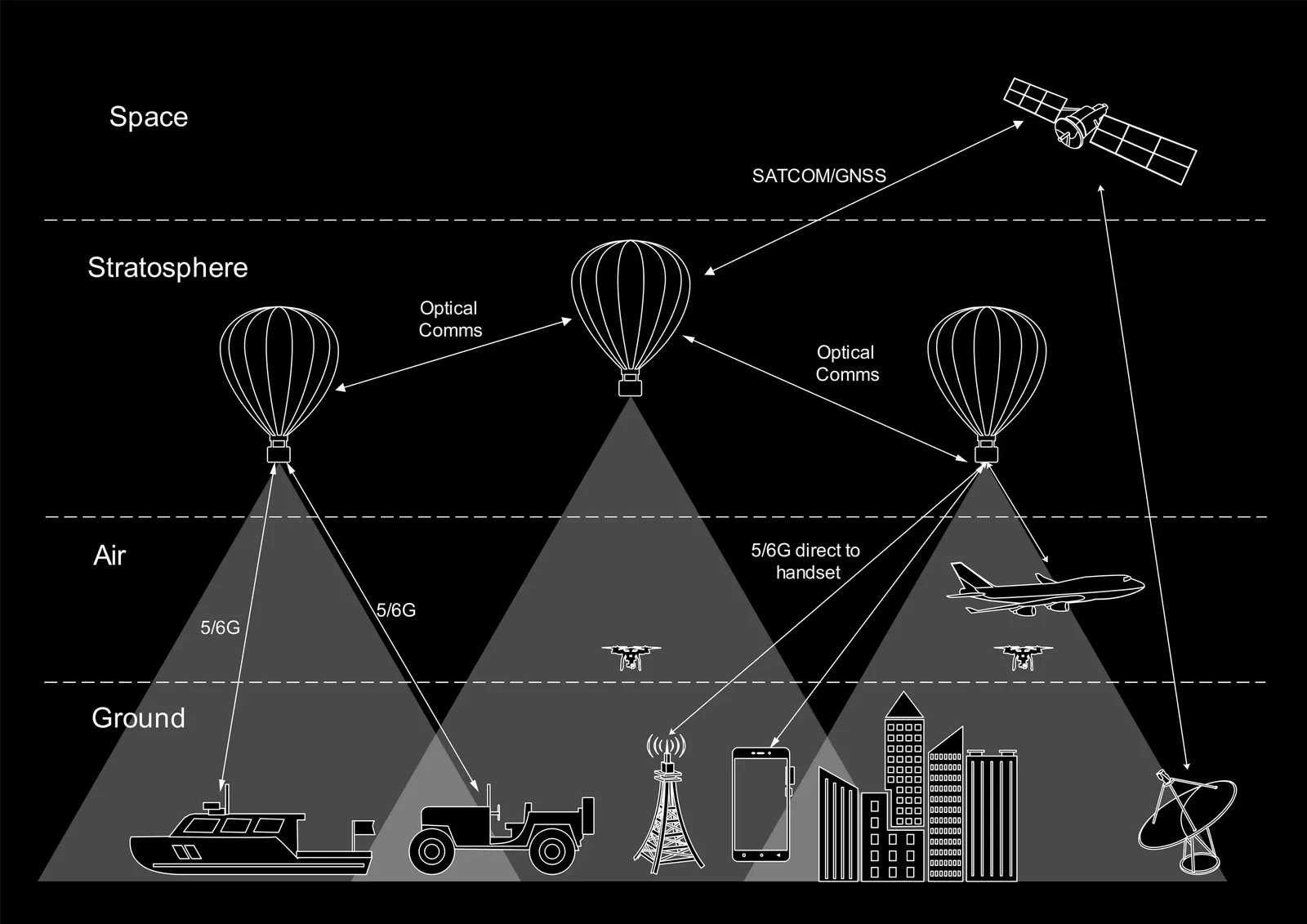
The authors make several arguments for platforms in the stratosphere, between towers and satellites:
Stronger signals. Platforms are far closer to the ground than satellites, so signals have less distance to travel.
Wide coverage. The authors estimate that one platform could cover 15 to 20 times the area of a standard ground tower.
Easier to secure. A platform stays within one country's airspace, which the authors say makes it harder to intercept or jam.
Cheaper to launch and upgrade. No rocket is needed, and a platform can be brought down for maintenance or new equipment.
Lighter footprint. Compared with large satellite constellations that eventually burn up on re-entry.
They also describe experiments linked to KAUST that tested signals between a platform and users who were stationary, driving and on a boat, which the authors say showed high data rates and near-continuous 5G coverage from the stratosphere.

Why this matters in Canada
Canada has many of the conditions the authors describe: remote and northern communities, long coastlines and huge areas of forest with little infrastructure. Connectivity there is also about safety. When a wildfire or a storm takes out towers and power lines, responders and residents can lose communications exactly when they need them most.
StratoHAB is built to carry communications equipment as well as cameras and sensors. A high-altitude link can extend coverage over an area for a mission, whether that is supporting crews at a fire or reaching a site with no network at all. We plan each communications mission around the coverage and connections the team needs.
Want to explore what an airborne link could do for your area? Plan a mission with us.